
BrightLocal: Local Consumer Review Survey 2026: Star Ratings Keep Rising, Old Reviews Don’t Cut It

Key Findings
- Star ratings and recency matter more than ever: Consumers now expect higher star ratings and fresh reviews, with a sharp increase in customers only using businesses with 4.5 + stars.
- The way we "read" reviews is changing fast: Consumers are looking beyond text reviews, with AI tools like ChatGPT surging into third place for local business recommendations.
- Reviews get consumers moving, but not always to checkout: Some are ready to buy, while most fan out to websites, social feeds, and other platforms for reassurance.
- Silence speaks volumes: Slow or generic review responses are increasingly seen as a red flag, as consumers expect businesses to acknowledge feedback almost immediately.
- Consumers want accountability for fake reviews: Shoppers want review platforms and businesses to step up, with severe consequences for those caught manipulating feedback.
Online reviews remain one of the most powerful drivers of trust and decision-making, but how people find and use them is in flux.
Each year, the Local Consumer Review Survey tracks the behavior of consumers around reviews, highlighting trends and insights that influence local businesses. It gives businesses the knowledge to adapt to shifts in online habits and create review profiles that consumers choose every time.
This year, we've focused on how reviews drive consumer actions, from checking websites, review sites, and social channels, or by taking the leap right into purchase.
Consumers Read Reviews More Than Ever, But How They Discover Them is Changing
Consumers are now more likely to read reviews, but the places they're looking are shifting, with AI and video growing. Google's dominance is slipping, but other review sites are picking up speed.
- 97% of consumers read reviews for local businesses
- The average consumer uses six different review sites when choosing businesses
- Google, Facebook, and AI tools like ChatGPT are most commonly used for local recommendations
- Traditional review sites like Tripadvisor, Better Business Bureau, and Healthgrades are seeing a resurgence, while Google is losing popularity
- Consumers are increasingly turning to video-based sites for local recommendations
2 in 5 Consumers Read Reviews Every Time They Look for a Business
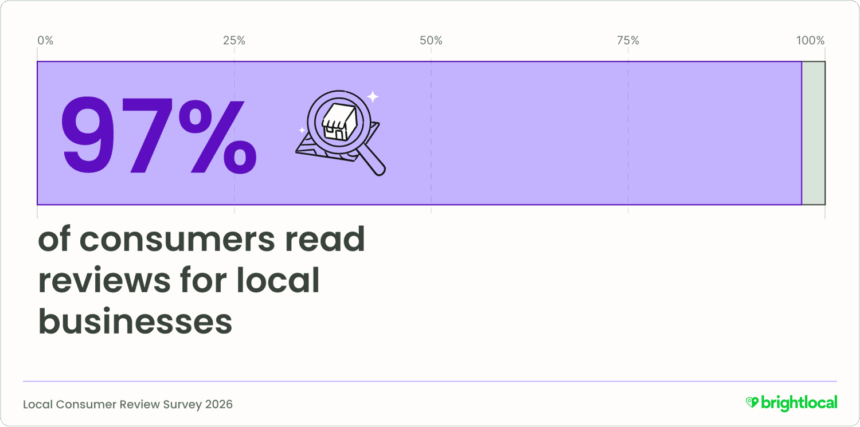
Reviews are a vital part of the business decision-making process, with 97% of consumers reading reviews online.
In 2026, 41% of consumers "always" read reviews when browsing for businesses, a huge jump from last year (29%).
Wider shifts may help explain why review-reading has become more important this year. The US economy grew more quickly than expected in 2025, after a slow start to the year following the USA's introduction of significant tariffs for many countries. Businesses adjusted supply chains and, in some cases, passed higher costs on to customers.
At the same time as rising prices, many consumers have had to dip into savings to handle economic changes, and product quality has declined in many industries. For both big brands and local businesses relying on third-party suppliers, substandard goods can make consumers wary. With higher prices and lower quality, it makes sense for savvy consumers to do more research before choosing a business.
Google is Losing Traction, but AI and Video Reviews are Picking Up Speed
The Top Sites for Reviews in 2026
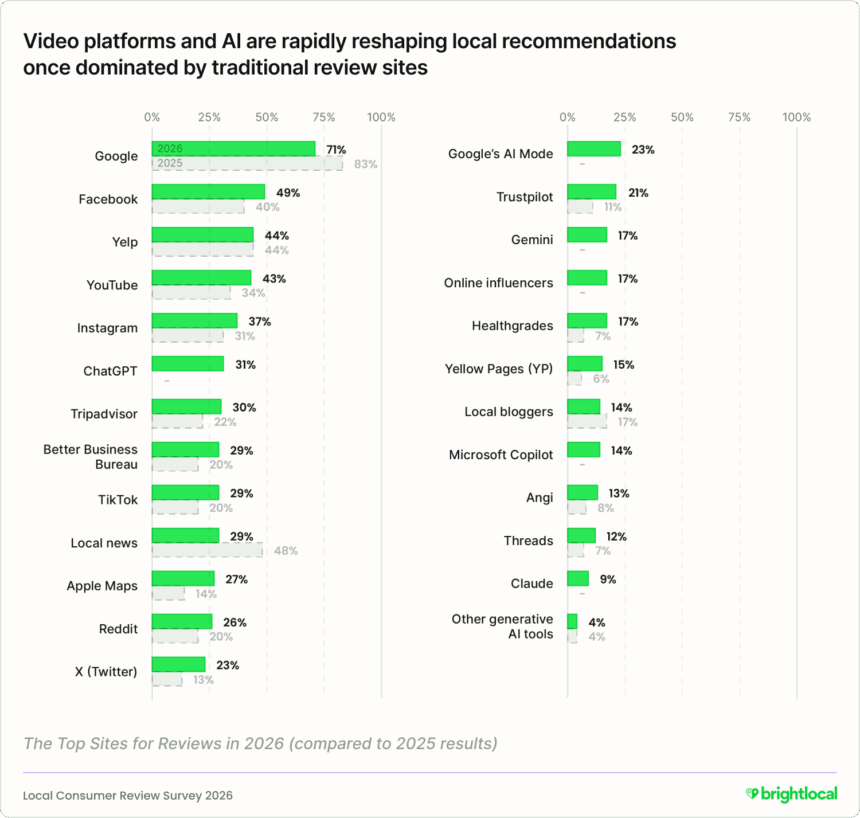
With consumers using an average of six review sites in 2026, relying only on the major review sites is no longer enough.
Google has always been the standout source for reviews, but this year its share has dipped from 83% in 2025 to 71%. Of course, Google is still far ahead of other platforms, but recent BrightLocal research found that just 35% of SMBs have a Google Business Profile, leaving many consumers unable to read or write Google reviews.
Video platforms are on the rise, with YouTube, Instagram, and TikTok all gaining traction. These non-traditional reviews by both influencers and everyday users provide quick, visual, and engaging insights into businesses. TikTok's Local Explorer Program mirrors Google Local Guides, highlighting the growing importance of non-traditional reviews for consumers.
One key story this year is the growth of AI. You knew this was coming, didn't you?
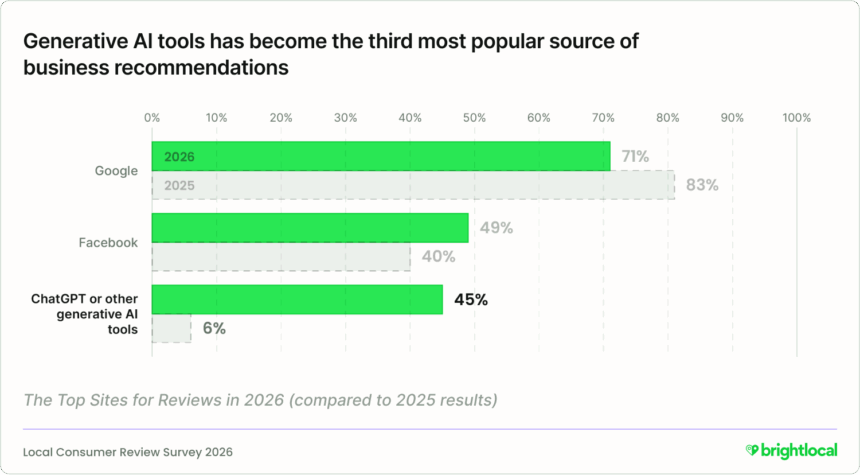
Use of ChatGPT and other generative AI tools for local recommendations has grown rapidly, rising from 6% last year to 45% and becoming the third most popular source of business recommendations.
However, it's not just newer technologies that are experiencing growth; many traditional review sites are too.
Facebook, Tripadvisor, BBB, Apple Maps, Trustpilot, Healthgrades, Yellow Pages, and Angi all saw increased usage over the last 12 months. Apple Maps nearly doubled in usage from 14% in 2025 to 27%. It seems clear that for 2026, traditional review sites have nothing to worry about.
Consumers Expect Higher Star Ratings and Recent Reviews
When deciding which business to use, consumers look far beyond the stars. The number of reviews a business has, the recency of its reviews, and the speed of the business owner's response all affect trust. Understanding what matters most can help businesses focus their efforts where they count.
- The most important review factor is consistent sentiment across multiple reviews
- In 2026, consumers expect a higher star rating and more recent reviews than in previous years
- 47% of consumers won't use a business that has fewer than 20 reviews
- 74% only care about reviews written in the last three months
- 31% of consumers will only use a business that has 4.5+ stars
How many reviews does a business need? Perhaps it's more than you think…
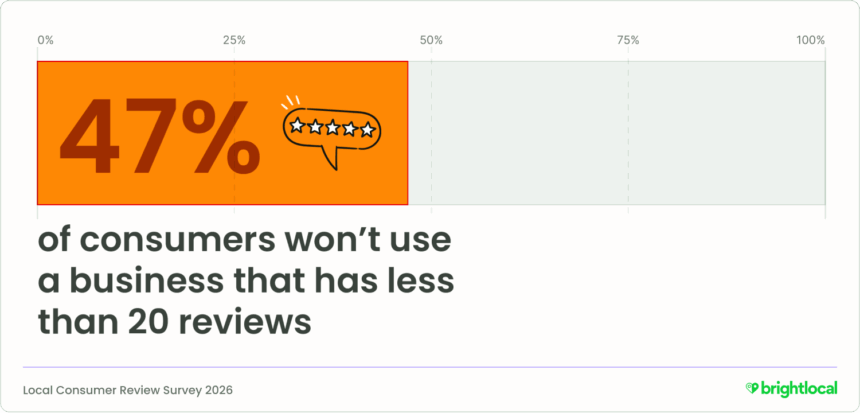
47% of consumers won't use a business with fewer than 20 reviews, and only 9% are willing to use one with five or fewer.
The number of reviews signals credibility to potential customers. Most customers won't base their decision on a single review: they want reassurance that a business consistently delivers a good customer experience. Even if they don't read every review, a higher review count creates social proof and reduces perceived risk.
For new businesses, collecting reviews from early customers is crucial. Nobody wants to be the first to take a chance, so showing that people have already trusted your business helps reassure potential customers.
Reviews Matter for Purchases Big and Small
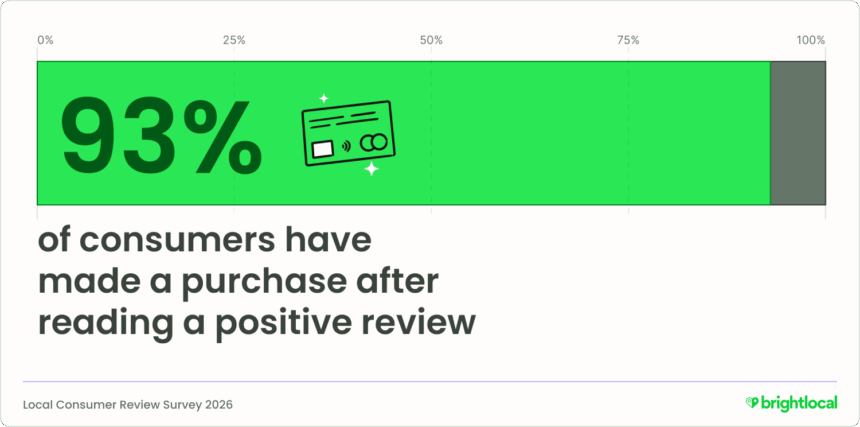
For many consumers, reading reviews is a key part of the purchase journey. 93% of consumers have made a purchase after reading reviews. In many cases, purchases are relatively small, with half spending less than $500.
Reviews are not just for restaurants or tourist spots; consumers regularly rely on them for high-value purchases. In fact, 27% of consumers have spent more than $1,000 after reading reviews, with 13% spending over $5,000.
Reviews Reduce Risk, But Don't Eliminate ItDespite reviews being highly trusted and used by consumers, reading reviews is not always enough to prevent buyers' remorse. 70% of consumers have made a purchase they regretted after reading reviews.
For 18% this was less than $50, but for many, the money wasted was significantly higher. 14% regret spending more than $1,000 after reading reviews, with 2% regretting spending more than $10,000.
Reviews can help consumers make more informed decisions, but they are not infallible. Fake or misleading feedback has the potential to cause significant financial consequences, even for careful shoppers. This reinforces why review authenticity matters as much as quantity.
Consumers Demand Real Consequences from Fake Reviews
Fake reviews remain a major concern for consumers and businesses. Misleading feedback can influence decisions and even lead to wasted money. With new regulations in place, fake reviews finally face scrutiny, with consumers expecting action from review sites and significant punishments for wrongdoers.
- 97% of consumers think businesses should face punishment for fake reviews
- Consumers believe businesses caught using fake reviews should be banned from review platforms (57%) or removed from Google search results (46%)
- 16% think fake reviews should result in criminal charges or jail time for the business owner
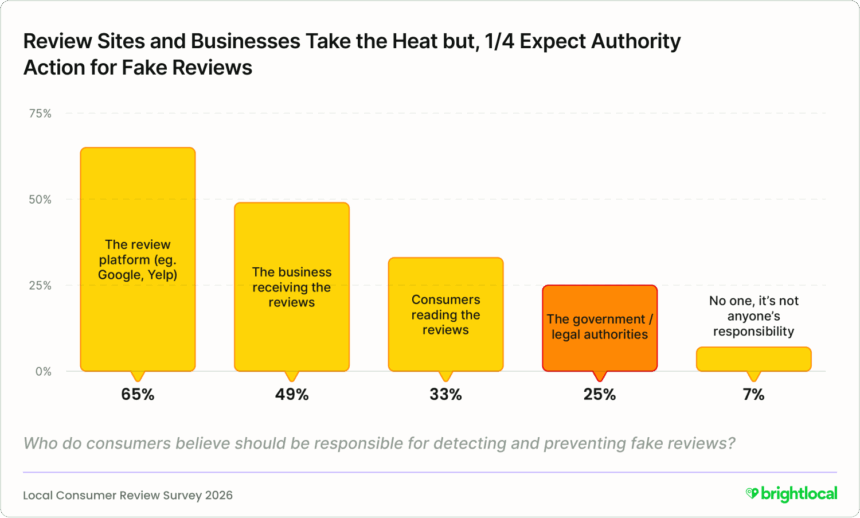
- 63% of consumers think review platforms should be responsible for detecting and preventing fake reviews
- 25% think the government and legal authorities should be detecting and preventing fake reviews
Review Sites and Businesses Take the Heat, but 1/4 Expect Authority Action for Fake Reviews
For years, fake reviews have been testing consumers and businesses. In 2024, the FTC introduced the long-awaited law regulating fake and misleading reviews. This law makes buying and writing fake reviews illegal, with any business or individual caught facing significant fines.
But should businesses be responsible for catching fake reviews? Yes, according to 49% of consumers. For now (and let's be realistic, for the foreseeable future), it falls to businesses to spot and report fake reviews themselves.
Consumers are most likely (63%) to believe the onus for stopping fake reviews should sit with review platforms. Google blocked 240 million fake or policy-breaking reviews in 2024. Even at this scale, fake reviews are a lingering problem made worse by scammers attempting to game the system or even extort businesses.
A quarter (25%) believe fake reviews should be the responsibility of the government or legal authorities. The new law provides clear rules on fake and misleading review practices, but it seems pretty unlikely that official sources will spend much time spotting fake reviews.
The Review Outlook for 2026
Reviews remain an important tool for businesses, but in 2026, consumer behavior is shifting. People are seeking recommendations from a wider range of sources, including video and AI platforms. Google is seeing dips, while other review sites are growing.
Consumers expect higher star ratings and recent reviews to guide decisions. As well as influencing trust, reviews are driving action. For many, reviews lead straight to high-value purchases, while others follow up with more research before jumping into a decision.
Businesses' requests for reviews continue to influence customers to write them; however, some businesses are breaking the law by asking for explicitly positive reviews.
Fake reviews continue to worry consumers, with many wanting more action and harsher punishments. With many consumers regretting purchases even after reading reviews, shoppers want to feel able to trust the legitimacy of reviews.
AI is picking up speed for local searches, with consumers using a variety of tools to find information about businesses. We'll be digging more into the link between AI and local business recommendations soon, so make sure you've subscribed to our newsletter to read this first.
Thanks for reading this year's Local Consumer Review Survey; we hope it has given you practical insights and actionable next steps for your business.
Co plete text at BrightLocal

Small Business Websites: 8 Reasons Why You Need One in 2026 by CyberOptik - Blog
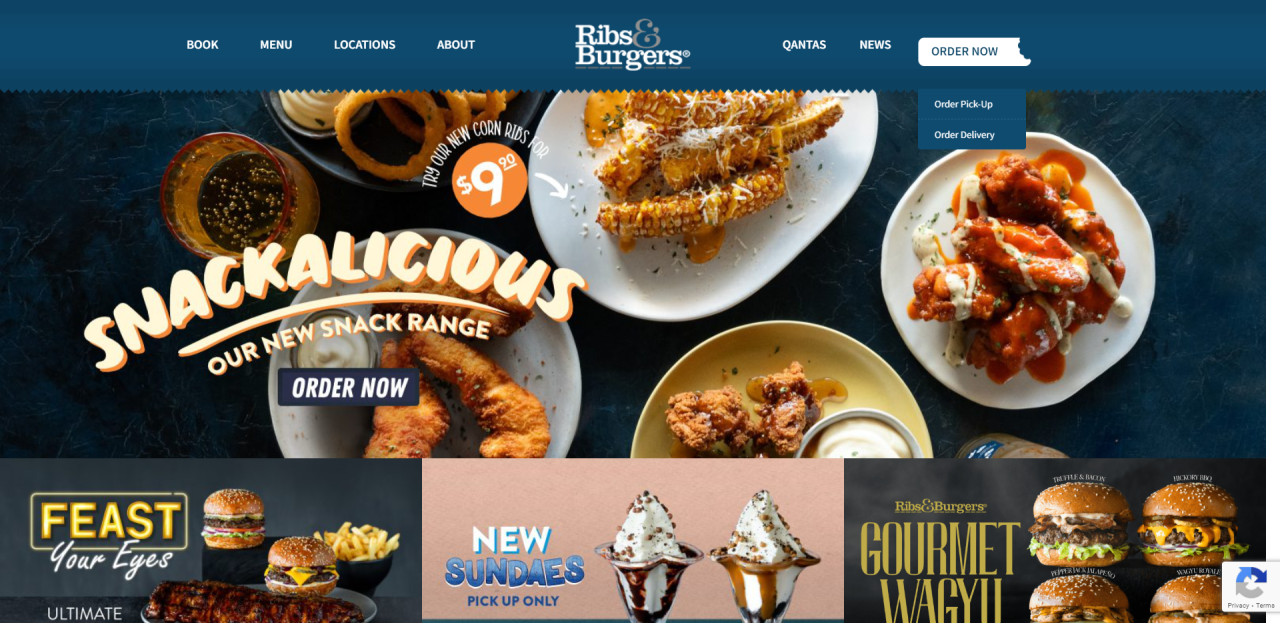
A list of the world's small business stores that inspire - Blog
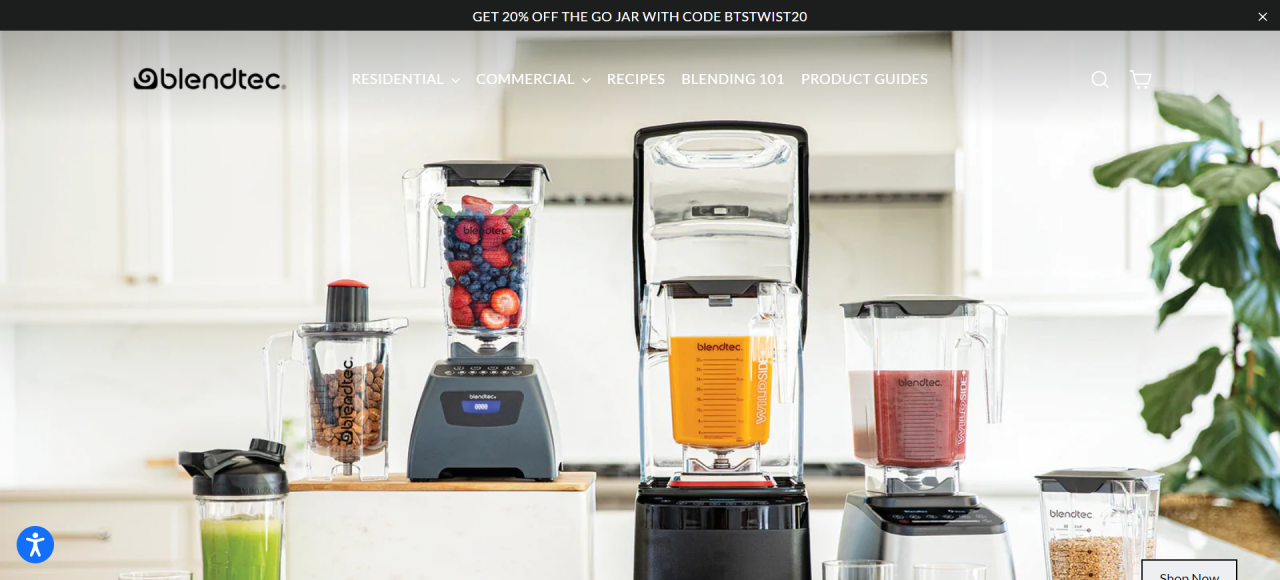
Blendtec - A great example of building a strong online presence and brand awareness - Blog

Website types - Blog
The marketing power of Landing Pages - Blog
When you subscribe to the blog, we will send you an e-mail when there are new updates on the site so you wouldn't miss them.